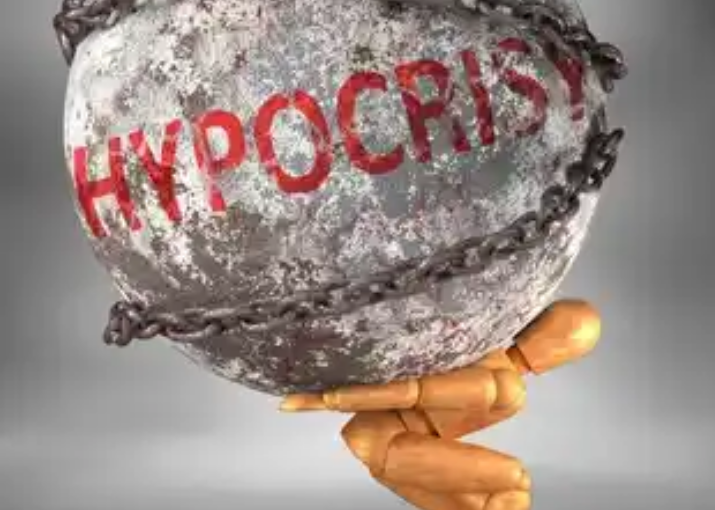
Is Hypocrisy a Natural Human Flaw?
The term ‘hypocrisy’ is said to derive from the Greek words ‘hupokrasis’ and ‘hupokrinesthai’, the former meaning ‘acting a part’, and the latter meaning ‘to act on a stage’.
What is Hypocrisy?
Hypocrisy is defined as the practice of claiming to have moral standards or views to which one’s own behavior (or the behavior of people in our family or tribe) does not meet. It is a pretense of morality that cloaks our inability to meet some predetermined moral code.
We accuse one person of doing exactly what we are doing but believe that it is somehow “different” when that person does it. It is typically caused by an inflated sense of ego and self-righteousness, coupled with an inability to be humble.
According to experts, it is a form of projection, which is a common defense mechanism that takes root in adolescence. It is a way to protect ourselves from harm. When a teenager is accused of some wrongdoing, he/she might claim “well my brother did it too!” Its purpose is to avoid personal responsibility and to gain control over a situation without admitting any wrong responsibility.
What Causes Hypocrisy?
At the root of hypocrisy is fear and low self-esteem. We use hypocrisy to avoid looking at our shortcomings and figure out our part in it. It typically stems from a sincere belief that we should not be held to the same standards as others because we have better intentions. Our belief is juster, nobler, and sincerer.
It feels good to be morally superior to someone else. It helps us to avoid humility, which is a very painful emotion. Even the best of us use hypocrisy when we feel attacked. For example, in the workplace, we may enjoy gossiping about our coworker’s poor performance but are secretly concerned about our own job performance. It’s a deflection to avoid dealing with our own problems because we don’t want to be judged.
At the root of hypocrisy is a strong desire to be loved and accepted. The fear of humility and judgment is so powerful, that we use doublethink and cognitive dissonance to avoid facing ourselves.
What is morality? Where does it come from? According to neurophilosopher Patricia S. Churchland in her book Braintrust (Princeton University Press, 2011), morality originates in the brain. She argues that over time the human brain evolved to feel social pain and pleasure. As humans evolved to care about the well-being of others, they also developed a sense of morality.
Robert Kurzban believes that we are all hypocrites. But not to worry, he explains, hypocrisy is the natural state of the human mind. In his book Why Everyone (Else) Is a Hypocrite: Evolution and the Modular Mind (Princeton University Press, 2011), Kurzban asserts that the human mind consists of many specialized units, which do not always work together seamlessly. When this harmony breaks down, people often develop contradictory beliefs.
How is consciousness possible? In Soul Dust: The Magic of Consciousness (Princeton University Press, 2011), psychologist Nicholas Humphrey, a leading figure in consciousness research, proposes a startling new theory. Consciousness, he argues, is merely a magic show we stage inside our heads. This show has allowed humans to become aware of themselves and their surroundings.
Being a hypocrite is one of the worst things you can be called — you’re someone who criticizes others and yet does the same sin yourself. I have not seen a single politician who isn’t a hypocrite.
According to Dr. Susi Ferrarello of Psychology, hypocrites in ancient Greece were actors “who on stage had to pick the right words and right tones to give shape to a writer’s fantasy.” They had the work of interpreting or judging what to say behind a mask, and became known as work as a two-faced person.
Actors were, by nature, hypocrites. They played different roles that they themselves didn’t live by — and how is it much different today? Actors are paid to be someone they’re not, and they do it realistically and brilliantly.
The etymology of the word “hypocrite” comes from the words hypo and krinein in Greek — meaning “under” and “to sift, decide” respectively. The etymology means that actors could sift through or decide upon the right words to use, but the decision came from “under” a mask of the source.
In Greece, it was a technical term, and now, it’s a dirty word in politics and in interpersonal relationships. But in rhetoric and debate, hypocrisy was interpreted as a way to understand the other side, to give more space to a different argument to understand it better.
“In that case, paradoxically, the mask’s function was to create a closer contact with others without being dominated by one’s own inner tyrant: the ego,” Ferrarello writes.
She notes that being in contact with someone else means being a mask, mediating between oneself and others.
Hypocrisy, actually, didn’t have a bad meaning until hypocrisy met politics in the 4th century B.C. Demosthenes made fun of Aeschines, a famous Greek politician who was also an actor, basically the Ronald Reagan of his time.
So are the most sincere and “honest” people actually hypocrites? Are all human beings hypocrites?
Well, yes. As Ferrarello notes, hypocrisy comes from a fluidity, and an embrace of the fact that we can have a multiplicity of the psyche and the ability to be multiple characters.
T.S. Eliot, as Ferrarello points to, once said that Tiresias was the best hypocrite — as a person pretending to do something he cannot. Tiresias is someone who shows that life is ambiguous and incoherent. He is a living paradox — the blind man who is a prophet, who sees better than people with sight can see. Tiresias spent seven years as a woman for stepping on a pair of mating snakes, described by T.S. Eliot in “The Waste-Land” as an “old man with wrinkled dugs”. He is both liar and honest, accepting the paradox of his life as someone genuine as a hypocrite.
Eliot describes Tiresias as “blind, throbbing between two lives,” a unifier between the ancient and modern worlds, embracing his pained role of being many different people at the same time. He is a living paradox, wearing many different masks.
So are we, too, hypocrites? Are we also condemned to live with the multiplicity that Tiresias was doomed with? Are we natural deceivers and actors that play many different roles? Is being a hypocrite just, well, human nature?
I would argue that if we weren’t hypocrites, we would be perfect. And Lord knows that no human is perfect, that no human can maintain the utmost standard of purity and perfection in whatever respect. We preach to “love your neighbor,” but how often do we fail to love our neighbors? How often do we let our friends get away with the things we condemn others for?
We are all hypocrites, then. I don’t think there’s a single person that hasn’t said to do something and then acted in the exact opposite way they preached.
Summarizing the words of Pattie Huggins Deitrick;
We give ourselves passes on standards we hold others to. We give advice we don’t follow ourselves. We say we love connection and friendships and simultaneously express a need to isolate ourselves. We tell people how important it is to be vulnerable when we can’t do so ourselves.
Every human being is an unfinished work in progress. It’s not like we shouldn’t aspire to be less hypocritical and more aware of our shortcomings and ways we don’t live up to what we preach. Even when we call others hypocrites, we, too, are hypocrites. We should judge less knowing our own shortcomings — and yet it’s a constant back and forth, a constant fluid and dynamic struggle.
All of us are hypocrites. There’s nothing we can do to change us, as well as others. Hypocrisy is engrained in our biology and DNA — our cognitive dissonance wants to elevate ourselves and people in our own in-groups as righteous, others as not righteous.
The lesson we should take, perhaps, it to more forgiving of hypocrisy — for ourselves and for others. All of us fall short of our own moral codes and standards, and we spend our whole lives as works in progress. It’s a marathon, not a sprint, and since we’re all hypocrites, let’s be comfortable with the life of being a hypocrite, one that’s flawed and multifaceted.
The human condition is one of going back and forth, and we, always, will be going back and forth as hypocrites. Maybe we should stembrace it.
How Can We Stop Being Hypocrites?
To stop being a hypocrite, we must first examine our own moral code and determine whether there are any contradictions in it. Objective morality is the best tool to help us overcome hypocrisy. Objective morality is the belief that meaning is not open for interpretation, and that something is true regardless of who is involved in a situation. In other words, stealing is wrong in and of itself. Abuse is wrong in and of itself. Hurting someone’s feelings is wrong in and of itself.
We must also stop pretending to be anything other than human. We must admit that we are imperfect beings who are prone to make mistakes. We must learn to laugh at ourselves and look at our own shortcomings less seriously. We must recognize that every one of us is prone to wrongdoing.
Putting ourselves in other people’s shoes can also be helpful. Learn about others. Get to know your enemies. Think about where they are coming from. Do unto others as you would have done unto you. Think about how much it hurts to be accused of something that you are doing yourself. Putting ourselves in other people’s shoes can also be tremendously helpful in decreasing our inflated ego and self-righteousness.
Other tips include –
· Ignore what other people are doing and focus on yourself
· Stop condemning others so quickly
· Pinpoint context and how it alters the way that you think/believe
· Start paying attention to your cognitive dissonance

 Peak News