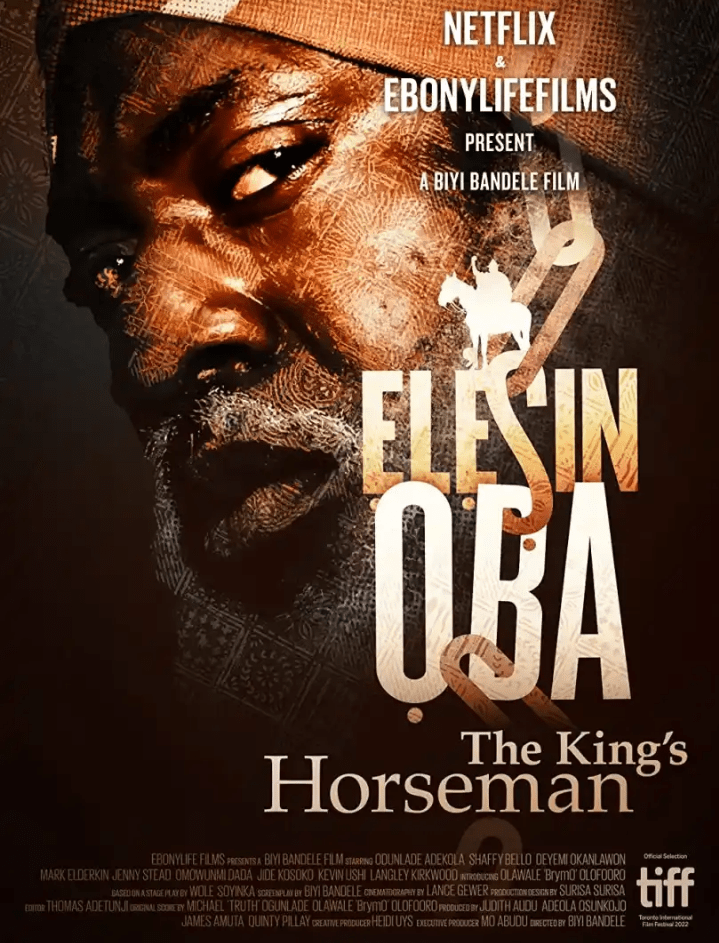
Based on authentic events in Nigeria’s Oyo of 1943, Elesin Oba: the King’s Horseman is a story set in the backdrop of World War II. Inspired by Wole Soyinka’s play titled Death and the King’s Horseman. The movie was tailored onto the screen, directed by Biyi Bandele, screenplay starring Odunlade Adekola, Shaffy Bello, Deyemi Okanlawon, Omowunmi Dada and more.
Top cast ; Odunlade Adekola · Elesin ; Shaffy Bello · Iyaloja ; Olawale-Brymo Olofooro · Praise Singer ; Deyemi Okanlawon · Olunde ; Omowunmi Dada · Bride.
The film was produced in partnership between Mo Abudu’s EbonyLife Studio and Netflix.
Running for a duration of 96 minutes, the movie centers across the lifestyles of the King’s horseman and Chief, who have to carry out the ritual sacrifice and comply with his King to the afterlife to maintain his community’s harmony. However, his initially putting it off to satiate his sexual appetite, and the following intervention of the British force’s comprehension of the same as ‘barbaric’, overturns the maintained balance in the Yoruba community.
The splendor of the movie starts with its screenplay being penned in the local mother tongue of the Yoruba community. Soyinka himself was a Nigerian writing in English, but one’s thought process is always ruled by their mother tongue which now finally finds its voice in the film adaptation. The onset itself takes us back to Yoruba origins telling their tale in their voice, foregrounding the basis of a good and diverse illustration.
Soyinka was keen on destabilizing the crucial evaluation of his play as a “clash of cultures” because that would basically correspond to the idea that both cultures were on the same plane, which wasn’t the case. The movie brings in the representatives of both cultures, while also presenting a middle ground in negotiating the terms between the two in Olunde’s character.
A steady emphasis is drawn on the term “The White Man’s Burden” coined by Rudyard Kipling as its portrayal is overturned in the storyline so presented. The savior complicated harbored by the British is all about setting the ‘savages’ free from the constraints of their ‘lesser’ culture and its customs. However, what this movie and Soyinka’s authentic play strive to achieve is a illustration of a community that barely got a chance to voice itself upon its agency being usurped by the colonial forces. The most essential takeaway is that if something stands far from one’s understanding, it doesn’t automatically become synonymous with being lesser than a counterpart deemed superior to it.
The British officer and his wife put on what are customarily the clothes of the dead as per the Yoruba culture but their seeming glittery visage is mistaken by the colonial forces as an embellishment or ‘costume’. They lack the basic understanding and context of the Yoruba culture and don’t even show any intentions of mastering about it, instead they choose to paint a picture of their own sense of calm and peace in the midst of a warring state of affairs by holding a grand ball that is to be graced by the Prince, who despite being the absolute symbol of western power, must stay aloof from the ground reality of those his Empire is supposedly ‘ruling over’.
Choices of costumes put on by either community are a symbol of their wonderful identities, yet even therein, markers of progress or the lack thereof are presumed, drawing out a hierarchy between them. The western dress of a suit and tie is accepted as sophisticated but the clothes sported by the African community, though closer to their humble origins are once again deemed starkly different, thus inferior by the former.
Bandele’s screenplay returns triumphant in yet another visual as well as auditory success as it retains Soyinka’s imaginative and prescient and focus on music highlighting the identity of the Yoruba mind. Bridging the gap between the “global of the living, the dead and the unborn”, the universality of their music founds the basis of the African identity. Moreover, music also acts as an aiding means of overall storytelling and narrating various events through their life – weddings, death, birth, and more.
While watching the film, viewers must turn away from lowering the dialectics of politics to a mere ‘conflict’ as stated before. Instead, we should take into count how each of these cultures has been ingrained in its counterparts. Neither of them should be declared a victor or a victim because each of them has its own share of shortcomings as well as aspects that need to be respected.
The Yoruba community is predominantly envisioned as matriarchal with women taking the lead and charging against the ones who seek to assault their culture. However, at the same time, in spite of their empowering stance, we can’t turn a blind eye to how young girls in the same community are made into silent bearers of the adults’ discretion, whether the decision is mindful or not.
A grand focus is paid to the notion of one’s duty – to one’s role, to one’s profession, to one’s family and community. Elesin puts off his duty to his King by giving in to his sexual desires, thus eventually overturning someone else’s life as well as his own into a tragedy. While the image of his suicide is viewed as a matter of celebration by both his community and himself, the colonial powers deem it as a crime being committed.
The storyline and the characters so presented are lined up to deliver a simple yet hard-to-accept message about both communities coming together to understand their respective perspectives. Violence only arises when the two fail to communicate and the dialectics of the Us Vs Them is ignited. Therefore, it isn’t necessarily the culture and customs that need to be held accountable but the actions of the individuals who are the markers and carriers of the same.
After king dies, a horseman need to sacrifice himself to serve his ruler in the afterlife – but sudden distractions lead to surprising tragedy.
Release date: 2022 (Nigeria)
Director: Biyi Bandele
Cinematography: Lance Gewer
Editor: Thomas Adetunji
music: Olawale ‘Brymo’

 Peak News